Grading English hammered coins
A hammered coin was struck by hand between two dies, on a blank somebody cut with shears. Almost everything that makes grading milled coins straightforward is missing, and the single commonest mistake is to mark a coin down for something the mint did in 1247.
Last updated 6 September 2026
Why hammered coins are graded differently
English hammered coinage runs from the seventh century to 1662. For all of that time a coin was made the same way: a blank was cut from a hammered sheet of silver, laid on a fixed lower die, topped with an upper die, and hit with a hammer. Every step of that is done by eye and by hand, and the coin records all of it.
The consequence for grading is that two coins in identical condition can look very different. One was struck squarely with a fresh die on a round flan; the other was struck off-centre with a die that had been in use for six months, on a blank that was slightly too small. Neither has been in anybody’s pocket. Grade is a statement about wear — about metal lost after the coin left the mint — and on a hammered coin you have to see past a great deal of noise to find it.
That is why the useful description of a hammered coin is usually three facts rather than one: the grade, the quality of the strike, and the state of the flan. A dealer’s “VF, well struck, full round flan” is not padding. It is three independent things, and a coin can be good at any one and poor at the others.
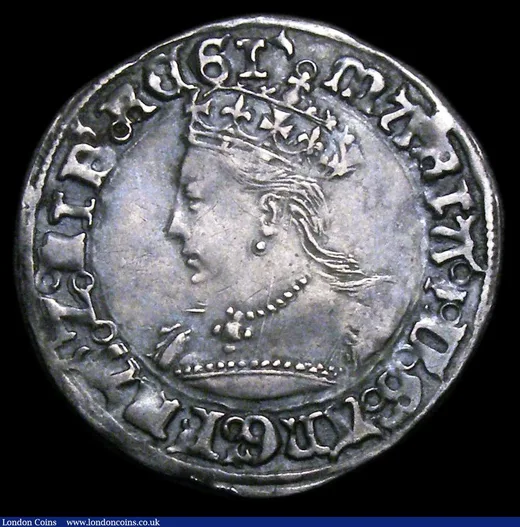
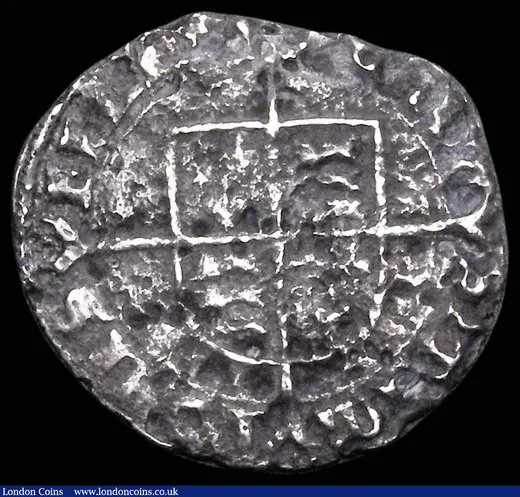
Groat, Mary (1553–4), mintmark Pomegranate · S.2492
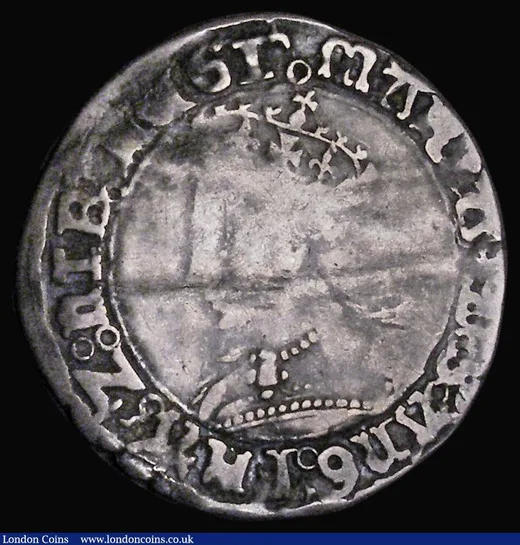
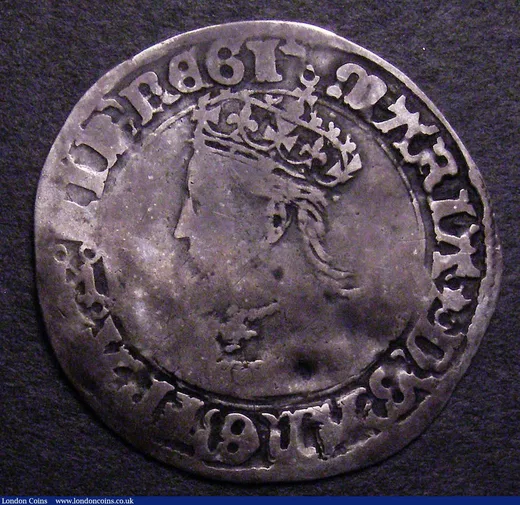
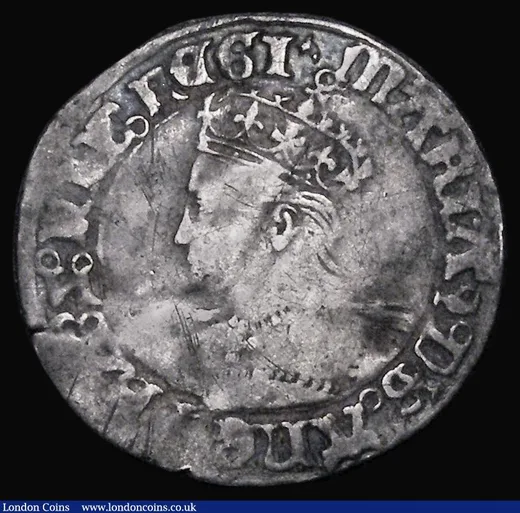
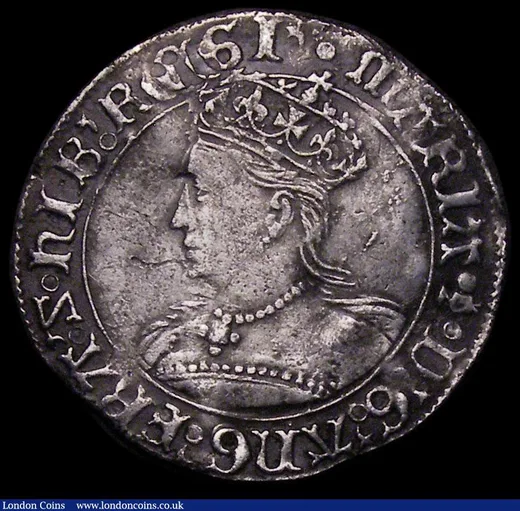
Striking weakness is not wear
This is the distinction to learn first, because getting it wrong in either direction costs money. Weakness and wear both remove detail. They do not remove it the same way.
| Weak strike | Wear | |
|---|---|---|
| Where it is | One area, often on both faces in the same place — the metal did not fill the die there. Frequently one side of the coin only. | Everywhere the coin stands proud, evenly across the whole face. |
| What it looks like | Detail is shallow but the edges of it are still sharp. The design is faint rather than rounded off. | Detail is rounded. High points are flat and slightly polished, with soft edges where a sharp one used to be. |
| The give-away | Fine detail survives in the low ground right next to the missing bit — a weakly struck bust can sit beside a crisp legend. | The highest points went first and the field is untouched. Wear never skips a high point to take a low one. |
Tilt the coin under a single light source and turn it. Wear catches the light as a flat, slightly shiny plateau. A weak strike does not — it stays matte and low, and the surrounding surface is undisturbed.
A weakly struck EF is still an EF
The flan: full, clipped, chipped, creased
The blank is the second independent axis. Hammered blanks were cut by hand, so an irregular outline is normal and not a fault. What is a fault is metal that has been removed or damaged since.
- Full flan — the whole design and the whole legend are on the coin, with the beaded border complete or nearly so. On most reigns this is uncommon and it carries a real premium. A full round flan can be worth more than a grade.
- Clipped — silver cut from the edge with shears, usually for its bullion value, which is why the practice was a capital offence. It shows as a straight chord across a curved edge and it takes the legend with it. Clipping is damage; note it separately and say how much of the legend survives.
- Chipped or cracked — the flan split at the edge, usually from being struck cold or from a stress point in the sheet. Common on the larger silver, and a small edge crack on a groat is a much smaller deal than the same on a penny.
- Creased or bent — thin silver folds. A coin that has been folded and flattened again shows a bright line across the face and often a hairline crack. This is usually the single most value-destroying thing on an otherwise good hammered coin.
- Double-struck or shifted — the coin moved between blows, so the legend doubles. Interesting rather than damaging, and on some coins collectable in its own right.
Where wear shows first
The order is the same as on any coin — the highest relief goes first — but on a hammered portrait the high points are in specific and slightly unexpected places, because the portrait is a facing bust rather than a profile for most of the series.
- 1The crown. Struck highest and worn first. On a Short Cross or Long Cross penny the fleurs and the band lose definition long before anything else.
- 2The face. The nose and cheekbones. On a facing bust the whole face is one plateau, so once it starts to go it goes evenly and quickly — this is the main thing separating Fine from Very Fine.
- 3The hair and beard. Fine punches in medium relief. Their survival is what usually distinguishes a good VF from an EF, and they are also the first thing a weak strike removes — check the other side before deciding which it is.
- 4The legend and beaded border. The lowest relief and the last to wear. A legend that is complete and sharp on a coin with a flat face means wear is less advanced than it looks, and probably means the face was weakly struck.
On the reverse, most of the series is some form of cross. The centre of the cross and the pellets in the quarters are the high points; the outer legend, again, is the last thing to go. A worn reverse cross on a sharp obverse is very often a strike issue rather than a wear one, because the cross sits opposite the bust and the two compete for the same metal.
The grades, and what they mean here
British collectors grade adjectivally — Fine, Very Fine, Extremely Fine — and dealers slice those finer with prefixes (nVF for nearly, gVF for good, meaning better than). Slabbed coins arrive with a Sheldon number instead, and CGS UK uses a scale of its own that runs to 100. They are not interchangeable, and the table below is how this catalogue reconciles them.
| Grade | British terms | Slab / American | Sheldon | CGS UK |
|---|---|---|---|---|
| Poor | PoorFairGood Fair | — | 1–5 | 1–6 |
| Good (G) | GoodVGnFAbout Fine | — | 6–11 | 7–11 |
| Fine (F) | FineGood FineChoice FineCh FGF | — | 12–19 | 12–19 |
| Very Fine (VF) | nVFA/VFAbout VFVFGood VFGVFChoice VFCh VF | — | 20–39 | 20–39 |
| Extremely Fine (EF) | nEFA/EFAbout EFEFGood EFGEFChoice EF | XFChoice XFCh XF | 40–55 | 40–55 |
| Near Uncirculated (nUNC) | A/UNCAU/UncaUNCnUNC | Choice AUCh AU | 56–59 | 56–62 |
| Uncirculated (UNC) | UNCGUNCGood UNCnFDCPractically FDCFDC | MSChoice MSCh MSSuperb MS | 60–70 | 63–100 |
Two warnings about that table, both of which matter more on hammered coins than on milled. The numbers are advisory: they exist to sort a collection and to pick comparable auction lots, and dealers disagree by several points on any of them. And the Sheldon scale was designed for early American large cents — machine-struck coins with consistent strikes — so it describes a hammered penny only loosely. The adjective is the real grade; the number is a filing system.
What each grade actually looks like on a hammered coin
| Grade | On a hammered penny or groat |
|---|---|
| Fair / Poor | Identifiable as a coin of the series and probably as a reign, and not much more. Legend mostly gone. These are collected for rarity or as a filler for a reign nobody can afford in better condition, and that is a perfectly respectable reason. |
| Good (G) | Type and reign clear. The bust is an outline; the crown is a shape rather than a crown. Some of the legend readable, often enough to place the mint if you are lucky with which part survived. |
| Fine (F) | The whole design is there and readable, worn evenly. Face flat but present, crown outlined, most of the legend legible. This is the commonest grade for medieval English silver and is a perfectly good collectable coin. |
| Very Fine (VF) | Detail within the design survives: eyes and nose distinct, crown ornaments separate, hair or beard visible as more than a mass. Legend complete where the flan allows. Light even wear on the highest points only. |
| Extremely Fine (EF) | Only the very highest points touched. Fine punch detail — individual hair strands, the pellets in the crown, the beading — all present and sharp. On hammered coinage this is scarce, and for many reigns and mints it effectively does not exist. |
| Near Uncirculated / Uncirculated | No wear at all — the coin never circulated. Almost always from a hoard. Note that an uncirculated hammered coin can still be badly struck, off-centre and on a ragged flan, because none of those are wear. “As struck” is the honest phrase and it does not promise a good-looking coin. |
Faults that are not grade
Each of these is recorded separately from the grade, because each affects value independently and a single adjective cannot carry them.
- Porosity and pitting — a rough, granular surface from centuries in the ground. Very common on detector finds. It does not remove design detail the way wear does, but it changes how the coin looks entirely, and heavily porous coins sell at a large discount to their apparent grade.
- Pecking — small test marks cut into the surface, usually with a knife, by somebody checking the metal was silver all the way through. Genuinely period, extremely common on late Anglo-Saxon and Norman pennies, and expected rather than disqualifying.
- Cleaning — the big one. Harshly cleaned silver has a bright, lifeless surface and fine parallel hairlines under a glass. It is irreversible and it is heavily penalised. Old cabinet toning is the opposite: it is desirable, it took a century to form, and it should never be removed.
- Tooling and smoothing — detail re-cut or fields smoothed with a tool to improve the look. This is misrepresentation rather than conservation, and a tooled coin is worth a fraction of an untooled one. Look for detail that is sharper than its neighbours and for lines that do not match the die’s own.
- Mounted or holed — a coin that was jewellery. A filled mounting mark is often visible as a slightly different colour at the edge.
Groat, Mary (1553–4), mintmark Pomegranate · S.2492
How to write it down
The description a hammered coin deserves is short and has four parts, in this order: grade, strike, flan, faults. For example — “gVF, well struck, full round flan, light porosity”, or “F, weak on the crown, clipped with about two-thirds of the legend, otherwise sound”.
That is the shape this catalogue records too. A coin carries one grade from the ladder above, with the strike, the flan and any faults written into the notes where they belong — rather than being smuggled into the grade, where the next person cannot tell them apart. If you also know the mint, that goes in as its own fact: it is worked out from the initial mark and the legend, and there is a separate guide to doing that and a tool that will do most of it for you.
The photographs on this page are catalogue images from London Coins, reproduced here to illustrate grading and credited individually with the sale and lot they come from. Each caption links to that house’s own record of the sale. The prices are what those particular coins made on those particular days — evidence of a market, not a price guide, and no guide to what yours is worth. The line drawings elsewhere on this page are ours.
The mark, legend and mint-signature tables behind this page are compiled from the reference tables published by Paul A Shields at psdetecting.com, cross-checked against Spink and North. The mint marks on this page are drawn by us rather than copied — the charges themselves are medieval and belong to nobody. Grades are advisory: dealers disagree by several points, and no number here should be read as a valuation.