Grading British milled coins
From 1662 English coins were made by machine, in a collar, on blanks of consistent weight. That removes almost all of the noise that makes hammered coins hard to grade — and replaces it with a much finer argument about lustre, contact marks and the last two points of a Sheldon number.
Last updated 6 September 2026
What changed in 1662
Milled coinage — struck by machine rather than by hand — was tried under Elizabeth I and again under Cromwell, but it became the permanent method at the Restoration. Charles II adopted the screw press and the edge collar, and the last English hammered coins were struck in 1662.
Three things follow, and all three change how you grade. Blanks are of consistent size and weight, so a milled coin is round and full unless something happened to it. The strike is applied with a consistent force, so weakness is a much rarer explanation for missing detail than it is on hammered coinage — if a milled coin looks worn, it usually is. And the edge is milled or lettered, which gives you something to check that a hammered coin does not have.
The result is that grading a milled coin is mostly a single question — how much wear? — where grading a hammered coin was three questions. The argument moves from “is this wear or strike?” to “is this EF or aUNC?”, which is a much finer distinction and worth a great deal more money.
Crown 1902, Edward VII · ESC 361
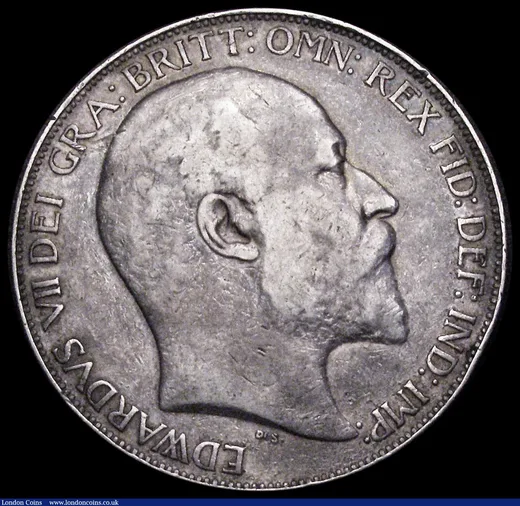
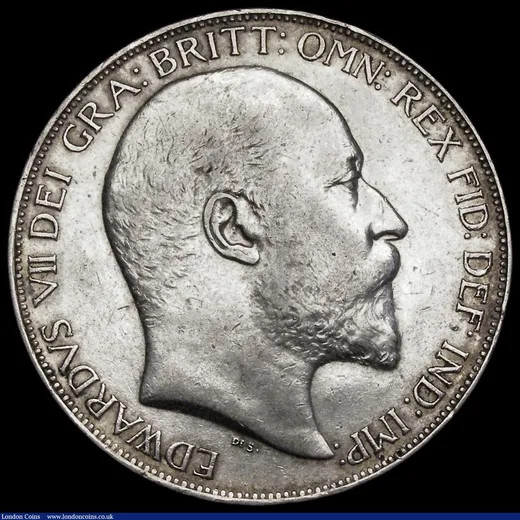
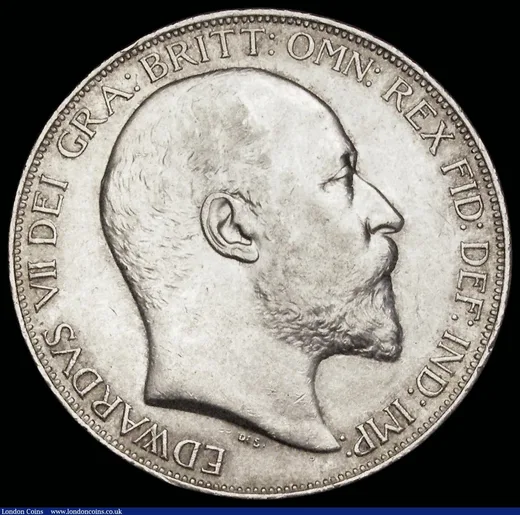
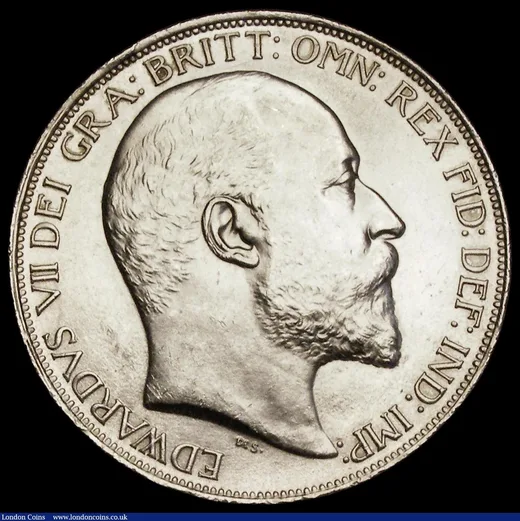
Where wear shows first
On a portrait coin the high points are the ones nearest you when the coin lies face up, and they are remarkably consistent across the whole series from Charles II to Elizabeth II. Learn these four and you can grade most British milled coinage.
- 1The hair above and behind the ear. The single most reliable place to look on almost every British portrait. Individual strands merge into a mass here first, and this is what separates EF from aUNC on a coin whose fields still look untouched.
- 2The brow, cheekbone and jaw. The next to go. A flattened cheek with hair detail still crisp is unusual and usually means the coin was rubbed rather than circulated — check for a corresponding flat spot on the reverse.
- 3The truncation and the shoulder. Where the bust is cut off. On the larger silver this catches on everything and takes wear early; on a sixpence it barely does.
- 4The legend and the rim. Last to wear, and therefore the sanity check. A coin with a soft face and a knife-sharp legend has usually been cleaned or rubbed rather than circulated.
On the reverse it depends on the design, but the principle does not: find the highest relief and look there. Britannia’s knee and the top of her shield; the centre of a crowned shield and the arches of the crown; the high point of the lion on the George V florin; the horse’s hindquarters on a sovereign’s St George. On a wreath design, the ribbon bow at the bottom is the classic wear point and the reason wreath crowns are so often described as “EF but for the bow”.
Lustre, and the line between EF and UNC
Lustre is the fine radial sheen on a coin that has never circulated. It is not shine and it is not polish — it is a microscopic flow pattern in the metal, left by the way the blank moved outwards under the die. Tilt an uncirculated coin under a point of light and the lustre rotates round the surface like the beam of a lighthouse. Nothing else does that, and no amount of cleaning puts it back once it has gone.
This is the whole of the distinction between the top grades, and it is why the British vocabulary has so many words for it:
- UNC — no wear whatsoever. Full lustre, or lustre that has toned over without being disturbed. It may still have bag marks, and frequently does.
- aUNC / nUNC / A/UNC — the very highest points have the faintest rub, or the lustre is broken on the high points. This is a real and useful grade and it is the commonest honest description of a nice coin.
- GEF / gEF — good extremely fine: light wear on the highest points, often with much of the lustre still present in the protected areas around the legend and inside the design.
- EF — light wear on all the high points, lustre mostly or entirely gone from the open field.
Lustre is not a grade on its own
Bag marks, contact marks and eye appeal
An uncirculated coin has no wear, but it has almost certainly been in a bag with several hundred others. The small nicks and scratches this leaves are bag marks, and they are why two coins can both be genuinely uncirculated and be worth very different amounts.
This is the main thing the Sheldon numbers above 60 are measuring. MS60 and MS65 have the same amount of wear — none — and differ entirely in how many marks they carry and where they fall. A mark in the open field beside the portrait is far more damaging than the same mark hidden in the hair, and a mark across the cheek of a large silver coin is the worst place of all.
Eye appeal is the catch-all for everything a grade does not carry: attractive toning, a good strike, well-centred dies, no distracting marks. It is subjective and it is real — it is why one MS63 sells for twice another.
The four systems, on one ladder
A British collector runs into four vocabularies. Dealers and auction houses use the UK adjectival scale. American slabs and most third-party grading use Sheldon’s 1–70. CGS UK, the British service, uses 1–100. NGC grades ancient coins with a grade plus separate strike and surface scores. This table is how they reconcile.
| Grade | British terms | Slab / American | Sheldon | CGS UK |
|---|---|---|---|---|
| Poor | PoorFairGood Fair | — | 1–5 | 1–6 |
| Good (G) | GoodVGnFAbout Fine | — | 6–11 | 7–11 |
| Fine (F) | FineGood FineChoice FineCh FGF | — | 12–19 | 12–19 |
| Very Fine (VF) | nVFA/VFAbout VFVFGood VFGVFChoice VFCh VF | — | 20–39 | 20–39 |
| Extremely Fine (EF) | nEFA/EFAbout EFEFGood EFGEFChoice EF | XFChoice XFCh XF | 40–55 | 40–55 |
| Near Uncirculated (nUNC) | A/UNCAU/UncaUNCnUNC | Choice AUCh AU | 56–59 | 56–62 |
| Uncirculated (UNC) | UNCGUNCGood UNCnFDCPractically FDCFDC | MSChoice MSCh MSSuperb MS | 60–70 | 63–100 |
The prefixes are worth stating explicitly because they trip people up: n and a and About mean short of the grade named, so nEF is below EF. g and Good and Choice mean better than, so gVF is above VF. It follows that gVF and nEF describe almost the same coin, and which one a seller reaches for tells you something.
One point of confusion is deliberate here: Good on its own is a low grade — better than Fair, worse than Fine — while Good as a prefix means better than. Good Fine is above Fine, and a coin described simply as “Good” is well below it.
CGS UK is not Sheldon
This one is worth a section because reading it as Sheldon does real damage. CGS UK runs 1–100 and Sheldon runs 1–70, and the natural assumption — that a CGS number is a Sheldon number with more room at the top — is wrong in a specific and expensive way.
The two scales agree closely up to about 60. Above that they diverge sharply, because CGS spends forty of its hundred points on mint state where Sheldon spends ten. A CGS 75 is a good but ordinary uncirculated coin. Read as Sheldon it is off the end of the scale entirely, and clamped to 70 it becomes FDC — a coin two full grades better than it is.
| CGS UK | Sheldon equivalent | Reads as |
|---|---|---|
| 40 | 40 | EF |
| 50 | 50 | EF |
| 60 | 58 | nUNC |
| 70 | 62 | UNC |
| 75 | 63 | UNC |
| 80 | 65 | UNC |
| 85 | 67 | UNC |
| 90 | 68 | UNC |
| 100 | 70 | UNC |
These figures are computed by the same function this catalogue converts CGS grades with, using CGS UK’s own published equivalence. They are advisory, like every number on this page.
Reading a slab label
A third-party grade is a different kind of claim from a self-assessed one. Somebody grading their own coin is offering an opinion; a slab is a company staking its reputation on a number and guaranteeing the coin is genuine. Both are useful, and conflating them is how a “gVF” somebody guessed at ends up looking like a fact.
| On the label | What it means |
|---|---|
| MS62 | Mint State — no wear. The number is about bag marks and eye appeal, not about circulation. 60 to 70. |
| AU58 | About Uncirculated — the faintest rub on the highest point only. 50 to 58. A good AU58 often looks nicer than a marked-up MS61. |
| PF / PR 66 | A proof: struck twice from polished dies for collectors, not for circulation. A proof is not a grade of a currency coin, it is a different thing that happens to share a design. |
| ★ / Star | NGC’s mark for exceptional eye appeal at that grade. |
| Details / UNC Details | The company graded the wear but the coin has a problem it will not net-grade — cleaned, scratched, damaged, tooled, mounted. The word after “Details” is the important half of the label, not the grade before it. |
| CGS 82 | CGS UK’s 1–100 scale. See the section above — this is roughly Sheldon 66, not Sheldon 82. |
Crown 1902, Edward VII · ESC 361
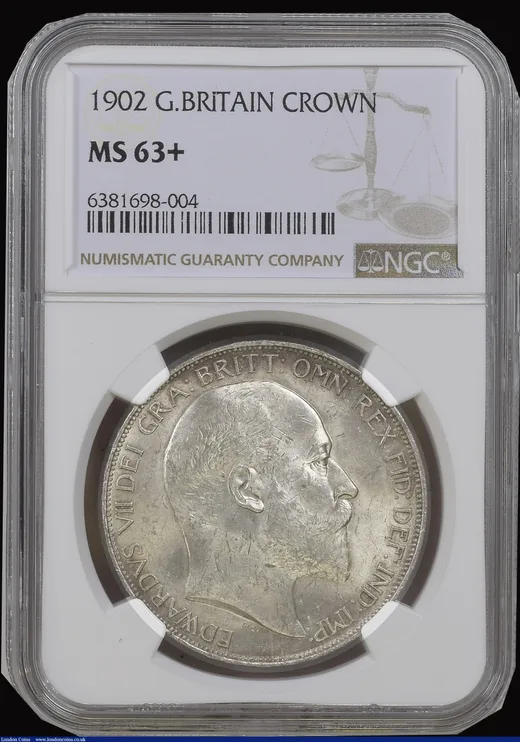
NGC Ancients, which is a different system again
Roman and Greek coins graded by NGC carry three things rather than one: an overall grade, a strike score out of five, and a surface score out of five. That is a sensible response to the same problem hammered coins have — an ancient coin’s appeal is mostly about how well it was struck and what the centuries did to the metal, and a single adjective cannot hold all three. This catalogue stores all three separately for exactly that reason.
Cleaning, toning and what not to do
Do not clean coins. It is the one piece of advice in this guide that is unconditional. Harsh cleaning leaves fine parallel hairlines, strips lustre permanently, and turns silver a flat unnatural white. It is detectable, it is irreversible, and it typically costs more than half the value of the coin.
Toning is not dirt. The grey, blue or golden film that forms on silver over decades is a stable sulphide layer, it protects the metal underneath, and on an attractive coin it is worth a premium. Original cabinet toning on a British silver coin is one of the most desirable things it can have. Removing it to make a coin “brighter” destroys value in both directions at once.
Verdigris on copper and bronze — the green crusty deposit — is different: it is active corrosion and it spreads. It is the one case where doing nothing is also a decision, and it is worth taking advice on a valuable piece rather than reaching for anything.
Handle coins by the edge, over a soft surface, and keep them out of PVC. Beyond that, the honest answer to “how do I improve this coin?” is that you do not — you record what it is. Which is what the rest of these guides are for.
The photographs on this page are catalogue images from London Coins, reproduced here to illustrate grading and credited individually with the sale and lot they come from. Each caption links to that house’s own record of the sale. The prices are what those particular coins made on those particular days — evidence of a market, not a price guide, and no guide to what yours is worth. The line drawings elsewhere on this page are ours.
The mark, legend and mint-signature tables behind this page are compiled from the reference tables published by Paul A Shields at psdetecting.com, cross-checked against Spink and North. The mint marks on this page are drawn by us rather than copied — the charges themselves are medieval and belong to nobody. Grades are advisory: dealers disagree by several points, and no number here should be read as a valuation.